An arch is the one piece of wedding decor that appears in almost every ceremony photograph. On a beach, it's the one piece most likely to fall over. Choose the shape for the pictures, and the anchoring for the weather.
The beach arch has a physics problem masquerading as a design question. Every shape below can look extraordinary against a horizon; they differ in how much wind they catch, how many flowers they need to look finished, and what they cost. Here is the honest field article: seven shapes, ranked by how they behave when the sea breeze picks up at 4 p.m., which on most coastlines is exactly when ceremonies happen.
The seven shapes
01: The circle (ring)
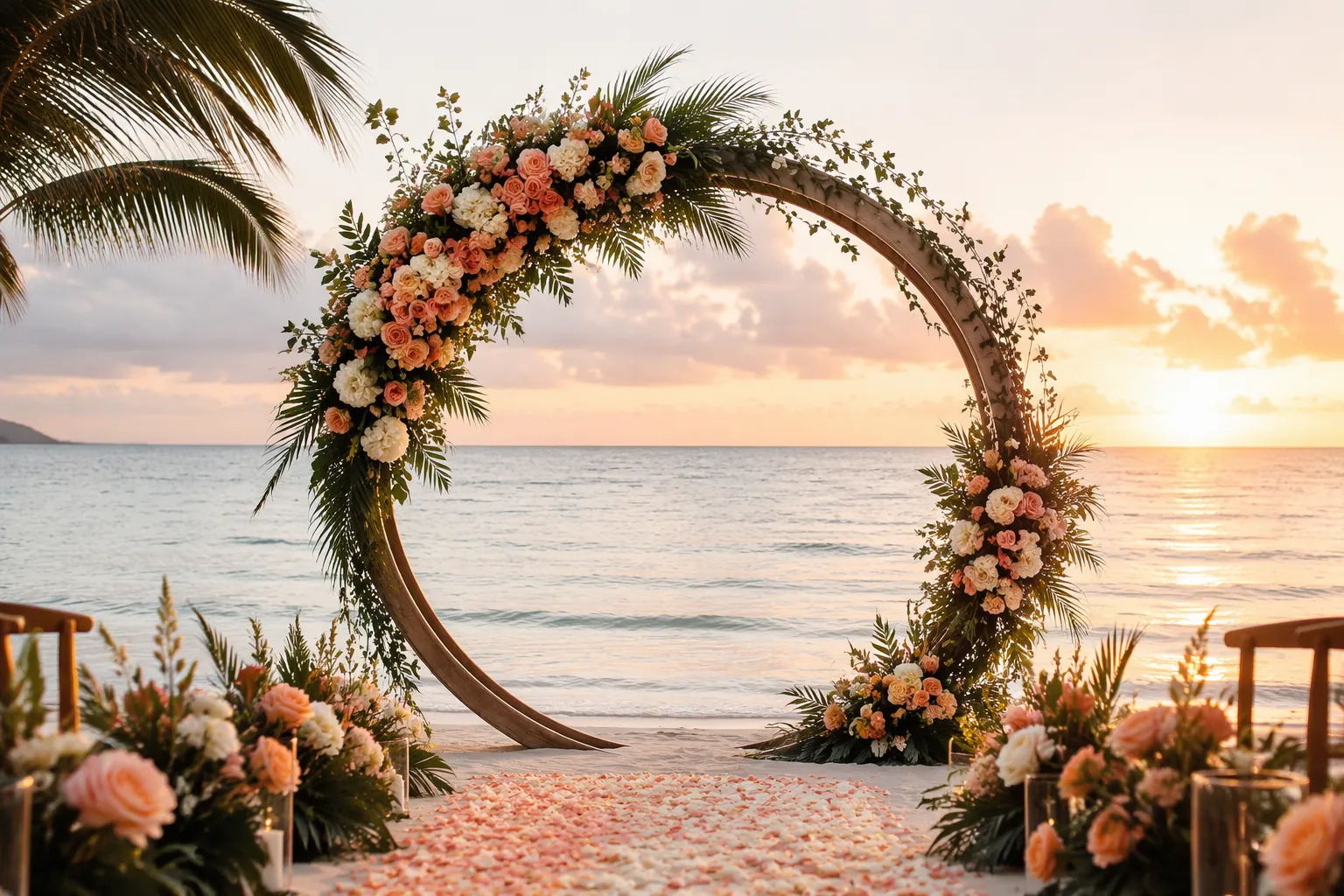
The beach staple, and for good reason: a ring frames the couple and the horizon in a single gesture, and the unbroken circle carries an obvious symbolism. Structurally it's friendly. A hoop presents less flat surface to the wind than a square frame of the same width. Floral coverage is often partial (a crescent over one shoulder of the ring) or full; partial coverage halves the flower bill and, honestly, often photographs better.
02: Asymmetric / deconstructed
The current editorial favorite: two posts of different heights, or a broken frame with the "missing" part implied by flowers. "We're seeing a real move toward the non symmetrical, offset look," as planner Nora Sheils of Bridal Bliss has put it. The arch that looks gathered rather than built. It suits couples who find the perfect circle too neat, and it naturally uses fewer stems.
03: The triangle
Sharp, modern, and the most structurally honest shape on this list. A triangle is inherently stable, and its low, wide stance handles gusts better than tall rectangles. Works beautifully with pampas, dried palms and bleached grasses for boho styling. The geometry is strong, so keep florals restrained: one dressed corner is often enough.
04: The hexagon
The geometric middle ground between circle and square, most often seen in gold or natural wood. Six sides read as intentional and contemporary without the severity of a triangle. Wind behavior is moderate; the shape wants balanced floral clusters at two or three of its vertices.
05: The square (grounded)
The classic four post chuppah derived frame. On a beach it catches the most wind of any shape here. Treat it as an indoor shape that can be adapted outdoors only with serious anchoring and a fabric strategy (sheer panels billow dramatically, which is either a feature or a hazard). Best positioned with its face parallel to the prevailing breeze, not square on to it.
06: Multi arch (overlapping)
Two or three arches of graduated size, layered to create depth. Striking in wide shots (the horizon visible through nested rings) and the backstage favorite of stylists because each arch can be dressed lightly. The catch: you're anchoring and transporting many structures, so labor costs climb.
07: Driftwood
The local material option: found or hired timber assembled into a rough arch, dressed with tropical foliage and a handful of blooms. It belongs on a beach the way no rental frame can, and its irregular surface hides mechanics beautifully. Weight works for you here, real driftwood is heavy, but check venue rules, since some beaches restrict structures or require permits.
The comparison table
| Shape | Mood | Wind behavior | Floral load | Typical cost |
|---|---|---|---|---|
| Circle / ring | Romantic, classic | Good: low profile to gusts | Partial to full | $800–$2,000 |
| Asymmetric | Editorial, modern | Very good: low center of gravity | Light to moderate | $700–$1,800 |
| Triangle | Boho, minimal | Excellent: inherently stable | Light | $500–$1,200 |
| Hexagon | Geometric, contemporary | Moderate | Moderate | $700–$1,600 |
| Square | Traditional, formal | Poor in gusts: needs serious ballast | Moderate to full | $800–$2,000+ |
| Multi arch | Dramatic, layered | Good per arch: more to anchor | Light per arch | $1,200–$2,500+ |
| Driftwood | Natural, site specific | Good: self weighted | Light | $500–$1,500 |
Costs reflect typical US market ranges for structure, fresh florals, delivery and installation; destination resorts often bundle arches into ceremony packages.
Field note, the anchoring conversation
Before you sign with any arch supplier, ask one question: "Exactly how will this be anchored, and what happens if it's gusting at ceremony time?" The right answer involves sandbags on every leg (15–25 kg per side as a starting point), steel base plates buried under sand, or pipe and drape hardware, plus a named person responsible for the call on the day. Get it in writing.
Dressing an arch for wind
Florals change the wind equation. Loose petals and wide, flat arrangements act like sails; clustered, wired, low profile work does not. The rules of thumb working beach florists use:
- Weight low, detail high. Concentrate arrangements at the base and one shoulder rather than a full sail of flowers across the top.
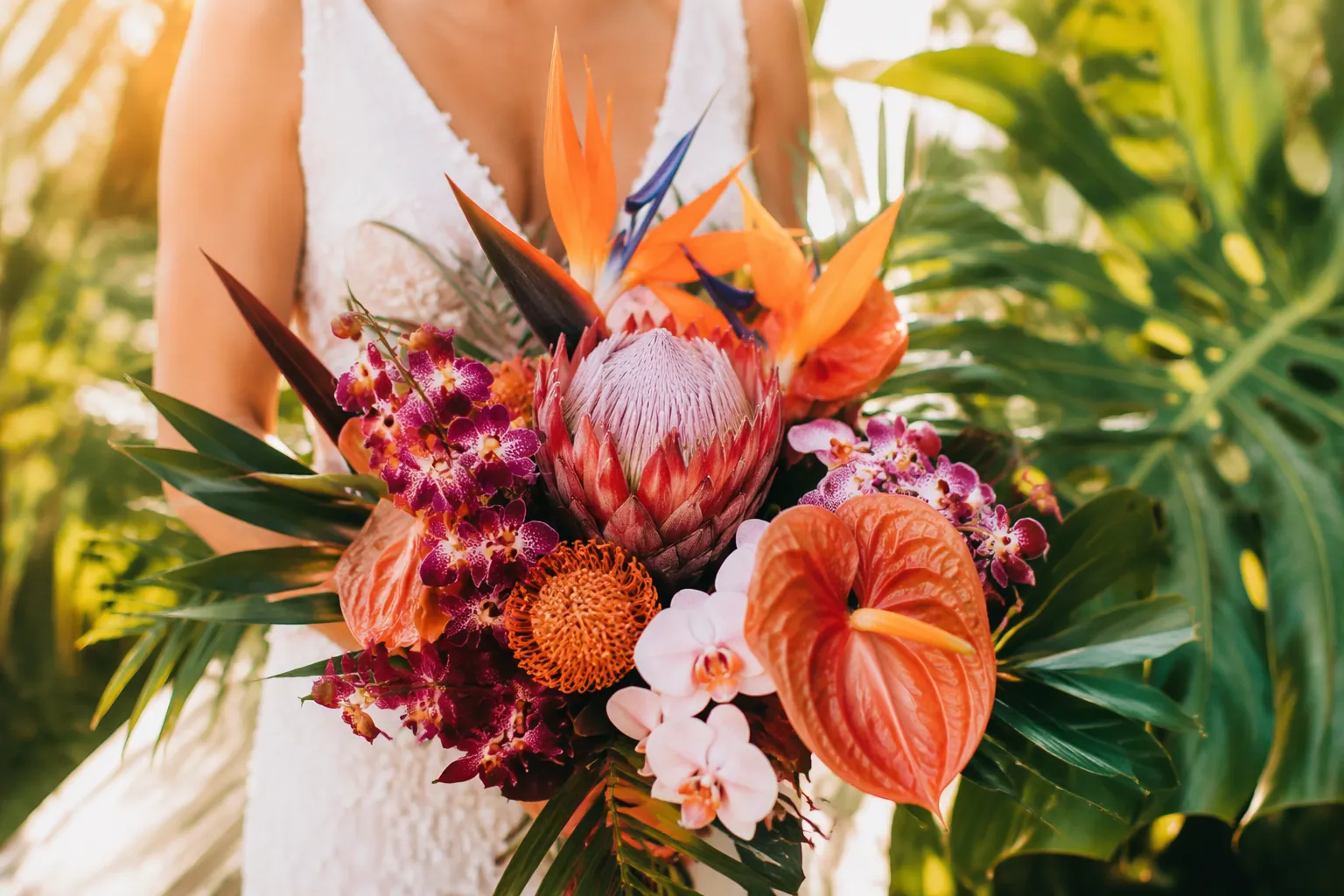
- Choose wind tolerant stems. Orchids, anthurium, protea and tropical foliage. The same heat proof cast from Pl. 01, plus dried pampas and palm fans, which neither wilt nor shred.
- Wire everything. Nothing glued, nothing tucked. If a piece can rattle loose, the sea breeze will find it.
- Time the tide and the breeze. On many coasts the wind peaks mid afternoon and drops toward sunset. One more argument for golden hour ceremonies.
The best beach arches look effortless because all of the effort went into the parts you can't see. The ballast, the wiring, the timing.
Pl. 02, working noteFrequently asked questions
The circle or ring arch is the beach staple. It frames the couple and the horizon in one gesture and carries an infinity symbolism couples like. Asymmetric and deconstructed arches are the fastest growing choice among styling led couples.
Industry pricing typically runs about $500 for a simply dressed structure and $2,000 or more for a fully florated custom build. Fresh flowers, labor and anchoring hardware are the three big cost drivers; dried palms and pampas reduce the floral bill.
Sandbags on every leg, often 15 to 25 kg per side as a starting point, more in exposed locations or afternoon sea breezes. Professional crews use pipe and drape bases or steel plates buried under sand. Ask your supplier exactly how the structure will be anchored and get it in writing.
Heat- and wind tolerant stems: orchids, anthurium, protea and tropical foliage, plus dried elements like pampas grass and palm fans that don't wilt and don't catch the wind like loose petals. Keep delicate blooms low and sheltered at the base.
Sources & further reading
- Junebug Weddings: ceremony structure galleries and planner interviews
- Style Me Pretty: beach ceremony design features
- Brides: arch trend reporting, including the asymmetric movement