"Something loose and natural" is how most bouquet briefs begin. "Garden style, hand tied, twenty five to forty stems" is how they end. This article is the translation.
A bouquet is an engineered object: a shape, a stem count, a weight you'll carry for hours, and a price built from all three. Florists share a precise vocabulary for the shapes, and couples who learn even the basics of it get better quotes, better designs, and fewer surprises. Here are the eleven styles that cover nearly everything you'll see on a mood board: a $25 single stem up to a six pound cascade.
The main event: five shapes to know
Classic round
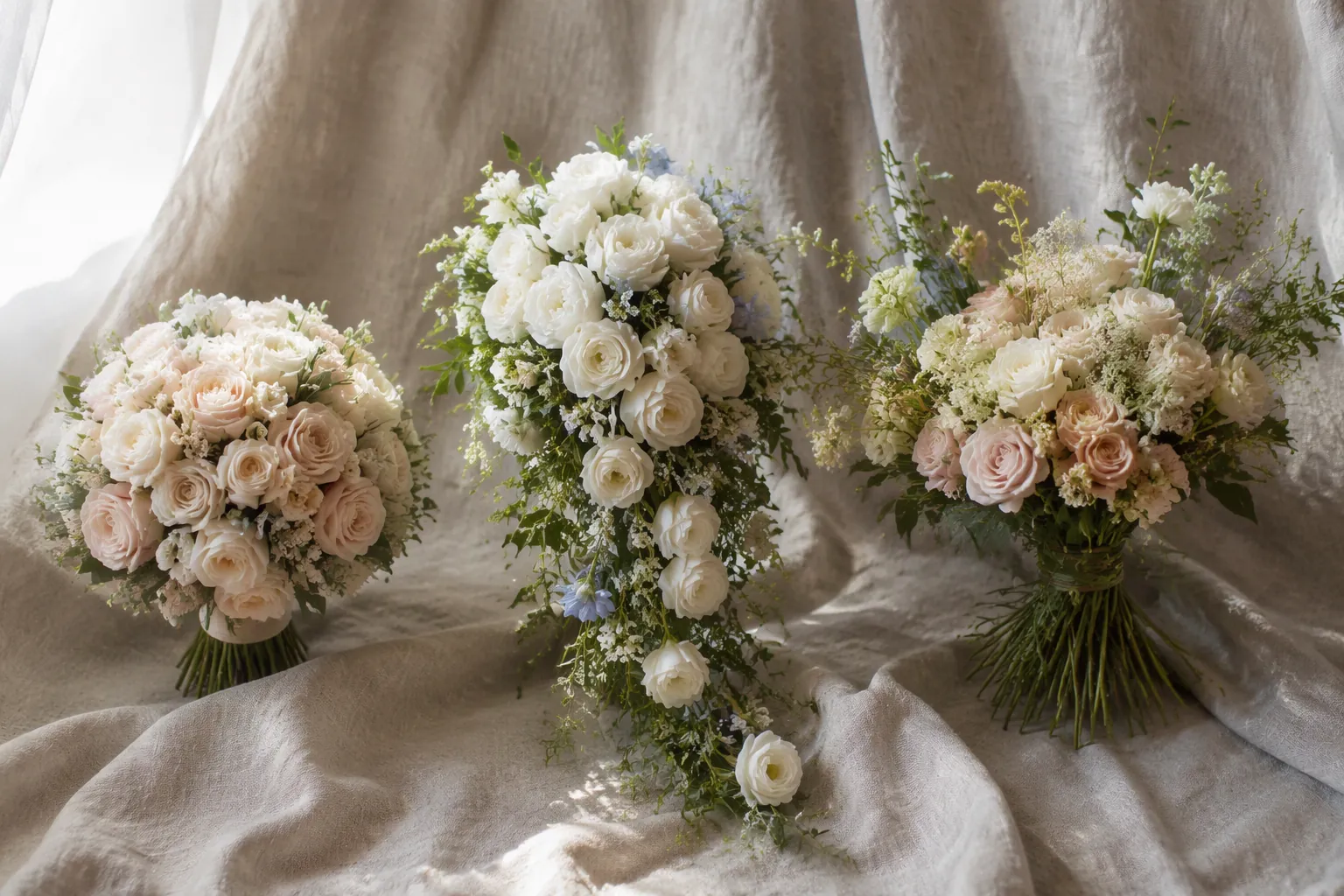
The formal standard. A dense dome of uniform blooms, often one or two varieties, stems cut to a single length and bound tight. Twenty to thirty five stems, $150–$250. It suits ball gowns, ballrooms and anyone who wants the flowers to look composed rather than gathered. The round is the most durable shape: nothing dangles, nothing snags.
Hand tied garden
The most requested style of the past decade, roughly four in ten bridal bouquets, and the one "loose and natural" often means. Stems are spiraled by hand and left longer, with mixed varieties and trailing texture; twenty five to forty stems, $175–$275. It moves naturally in photographs and forgives a long day better than wired shapes. If you're not sure what you want, this is the answer until proven otherwise.
Lush organic
The garden style taken further: asymmetric, generous, thirty five to fifty five stems or more, $200–$300+, and three to five pounds in the hand. This is the shape that fills editorial spreads, but know what you're signing up to carry through an hour of portraits. The weight is the price of the drama.
Cascading
The waterfall. A structured crown at the top, a flow line of blooms through the middle, and a trailing tail: full cascades run sixty to ninety centimeters, teardrop versions forty to fifty. Thirty to fifty plus stems, $225–$350 and up (premium versions pass $500), four to six pounds. The shape was made famous by Princess Diana's 1981 bouquet, which trailed well past three feet. The tail is wired stem by stem, which is why it's the most labor intensive shape a florist makes, and why a quote for one should never surprise you.
Asymmetrical / crescent
A bouquet with a deliberate lean: blooms weighted to one side in a crescent sweep. Twenty five to forty stems, $200–$300. It's the modern editorial compromise between the discipline of the round and the abandon of the cascade, and it photographs beautifully against a simple dress.
The full eleven, in one table
| Style | Stems | Weight | Typical price | Character |
|---|---|---|---|---|
| Classic round | 20–35 | ~2 lbs | $150–$250 | Formal, composed |
| Hand tied garden | 25–40 | 2–3 lbs | $175–$275 | Gathered, natural: most popular |
| Lush organic | 35–55+ | 3–5 lbs | $200–$300+ | Editorial, abundant |
| Cascading | 30–50+ | 4–6 lbs | $225–$350+ | Dramatic, trailing |
| Asymmetrical / crescent | 25–40 | 2–3 lbs | $200–$300 | Modern sweep |
| Posy / nosegay | 12–20 | ~1 lb | $100–$175 | Petite, six to eight inches across |
| Single stem | 1–5 | n/a | $25–$75 | Minimal statement: one king protea, one lily |
| Biedermeier | 25–40 | 2–3 lbs | $175–$275 | Concentric rings of different varieties |
| Composite / glamelia | n/a | 1–2 lbs | $300–$500+ | One "flower" built from hundreds of wired petals |
| Hoop / wreath | varies | 1–2 lbs | $100–$200 | Flowers wired to a ring: carried, not held |
| Pomander | 15–25 | ~1 lb | $75–$150 | Flower ball on ribbon: classic for flower girls |
Field note, the pageant bouquet
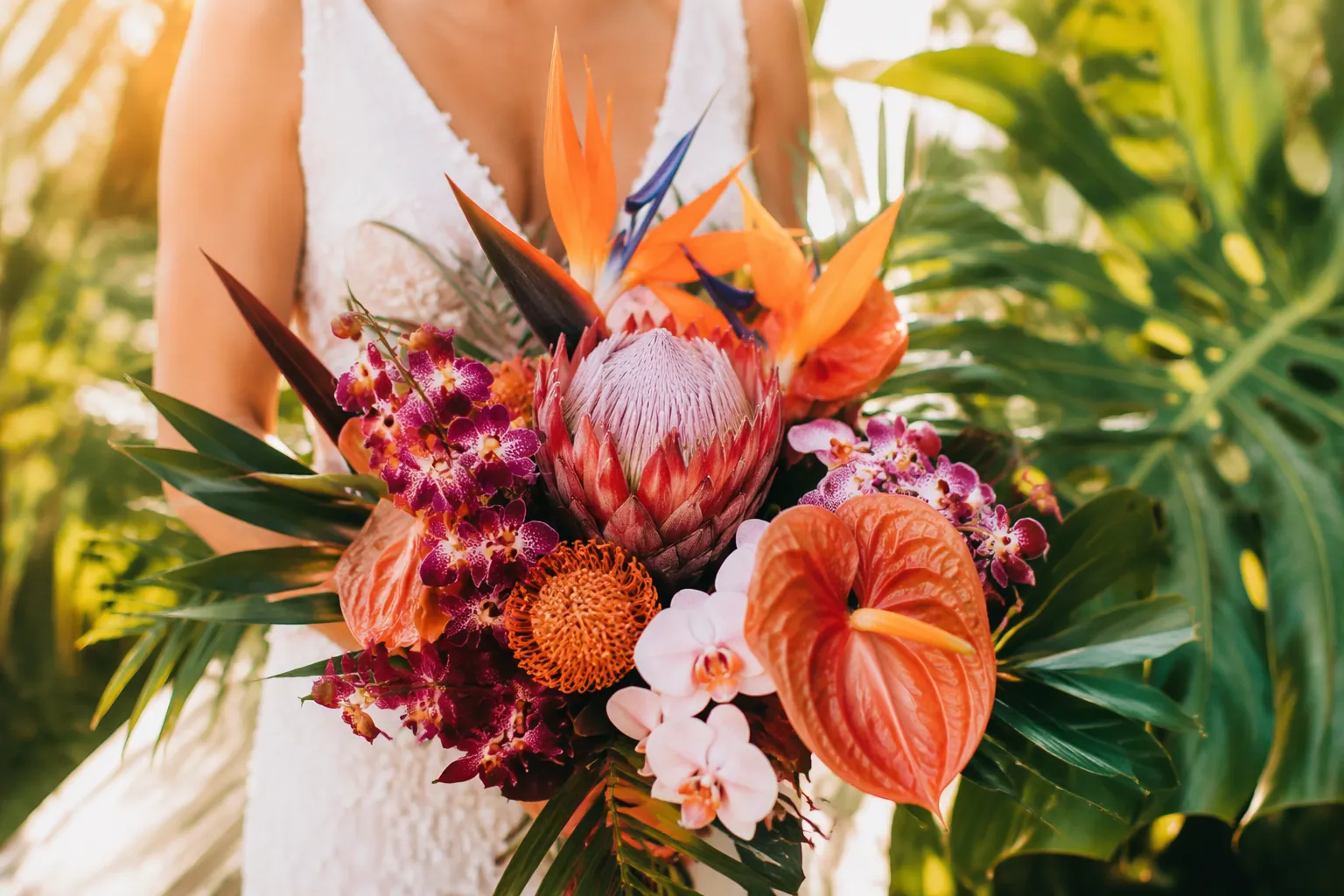
One more shape worth knowing: the pageant (or arm sheaf), long stemmed flowers designed to rest in the crook of the arm, Miss America style. It reads wonderfully with calla lilies and orchids, and it keeps both the dress and the flowers uncrushed in photographs.
Choosing for your dress and frame
Two proportion rules cover most of the decision. First, the bouquet's width should stay narrower than your torso: it should frame the dress, not hide it. Second, match the formality of the shape to the structure of the dress: a clean column or slip dress wants a composed shape (round, crescent, single stem); a romantic A line forgives the wildness of garden and organic styles; a ball gown can carry the full theater of a cascade.
And a practical note from photographers: whatever the shape, ask your florist to leave the stems a fraction longer than you think you want. Bouquets get held at the navel, and short stems push the whole arrangement up into the bust line of every portrait.
Anatomy of a cascade
Since the cascade commands the premium, it deserves a closer look. Florists build it in three zones: the crown (the compact heart of the bouquet, held in the hand), the flow line (the diagonal movement through the middle that keeps it from looking like a round bouquet with a tail glued on), and the tail itself: orchids, amaranthus, jasmine vine or ivy, wired individually so the line moves when you walk.
A well built cascade is lighter in the hand than its stem count suggests, because the weight is distributed along the wired spine rather than packed into the crown.
The bouquet is the single most photographed object at a wedding after the couple themselves. Choose the shape like you chose the dress.
Pl. 04, working noteFrequently asked questions
The hand tied garden style is the most requested, roughly four in ten bridal bouquets, because it looks gathered and natural while holding its shape through a long day. The classic round bouquet remains the formal standard.
A cascading bouquet typically runs $225–$350 or more, with premium versions above $500. It needs 30–50+ stems, can weigh four to six pounds, and is the most labor intensive shape a florist makes. The trailing lines are wired stem by stem.
It depends on shape and flower size: a posy might hold 12–20 stems, a classic round 20–35, a hand tied garden style 25–40, and a lush organic or cascade design 35–55 or more. Large headed flowers like peonies mean fewer stems; spray roses and fillers mean more.
Smaller, lighter shapes (a posy, a small round, or a compact hand tied) keep proportion with a petite frame and an unfussy dress. A full cascade or oversized organic bouquet can overwhelm both. As a rule, the bouquet's width should stay narrower than the bride's torso.
Most hand tied bouquets weigh two to three pounds. Lush organic styles run three to five pounds, and a full cascade can reach four to six: worth knowing before you commit to carrying one through an hour of photographs.
Sources & further reading
- The Knot: bouquet style articles and florist pricing
- Brides: bouquet shape history, including the royal cascade
- Flower bouquet: terminology and shape taxonomy