Of the thirty thousand orchid species on Earth, five do almost all the wedding work. Learn those five, and every centerpiece quote becomes legible.
The orchid has an unfair advantage over every other centerpiece flower: it grows as an epiphyte, clinging to trees in tropical canopies, and its waxy blooms are built to last weeks rather than days. A rose centerpiece is a race against the clock; an orchid centerpiece is furniture. In a warm reception room (the kind that turns hydrangeas to tissue by the first dance) orchids simply don't notice. Here's the field article to the five varieties that count, the four styling approaches florists use, and what it all costs per table.
The five working varieties
- Phalaenopsis (moth orchid). The elegant default. Long arching stems of large, flat, waxy blooms in white, blush and cream. One stem is a sculpture; three are a centerpiece. The most expensive per stem, the fewest stems needed.
- Cymbidium (boat orchid). The workhorse. Each stem carries eight to fifteen smaller blooms in green, burgundy, pink and gold, and it's the hardiest cut orchid in heat. The one florists trust in buttonholes and outdoor work.
- Dendrobium. Bought by the box: sprays of small blooms in white, purple and green, cheap enough to scatter across tables, thread into garlands, or sink by the dozen into cylinder vases.
- Vanda. The jewel. Large, flat faced blooms in saturated blues, purples and oranges. Sold as individual heads for floating or as statement stems; the bluest flower you'll find in nature.
- Oncidium (dancing lady). Clouds of tiny yellow and brown blooms on branching sprays. Adds movement and texture to mixed arrangements rather than standing alone.
| Variety | Look | Best use | Relative cost |
|---|---|---|---|
| Phalaenopsis | Large, sculptural, white/blush | Statement stems, potted designs | $$$ |
| Cymbidium | 8–15 blooms per stem, many colors | Mixed arrangements, outdoor events | $$ |
| Dendrobium | Small sprays, white/purple/green | Submerged designs, scattering, volume | $ |
| Vanda | Jewel tones, flat faced | Floating bowls, accent stems | $$$ |
| Oncidium | Dancing yellow sprays | Texture in mixed pieces | $$ |
Four ways to style them
The submerged stem
Dendrobium or phalaenopsis stems sunk in tall glass cylinders of water, weighted with a stone, often in a trio of heights. Modern, architectural, and nearly indestructible. The water keeps everything pristine for days, which means setup can happen a full day early. Around $80–$150 per table.
The potted orchid
A living phalaenopsis in a dressed ceramic pot, mossed at the base, sometimes with foliage tucked around. The smartest economics in wedding florals: immune to wilting, setup proof, and it leaves with a guest or the couple as a living favor. $100–$200 per table depending on plant grade and container.
The tropical arrangement
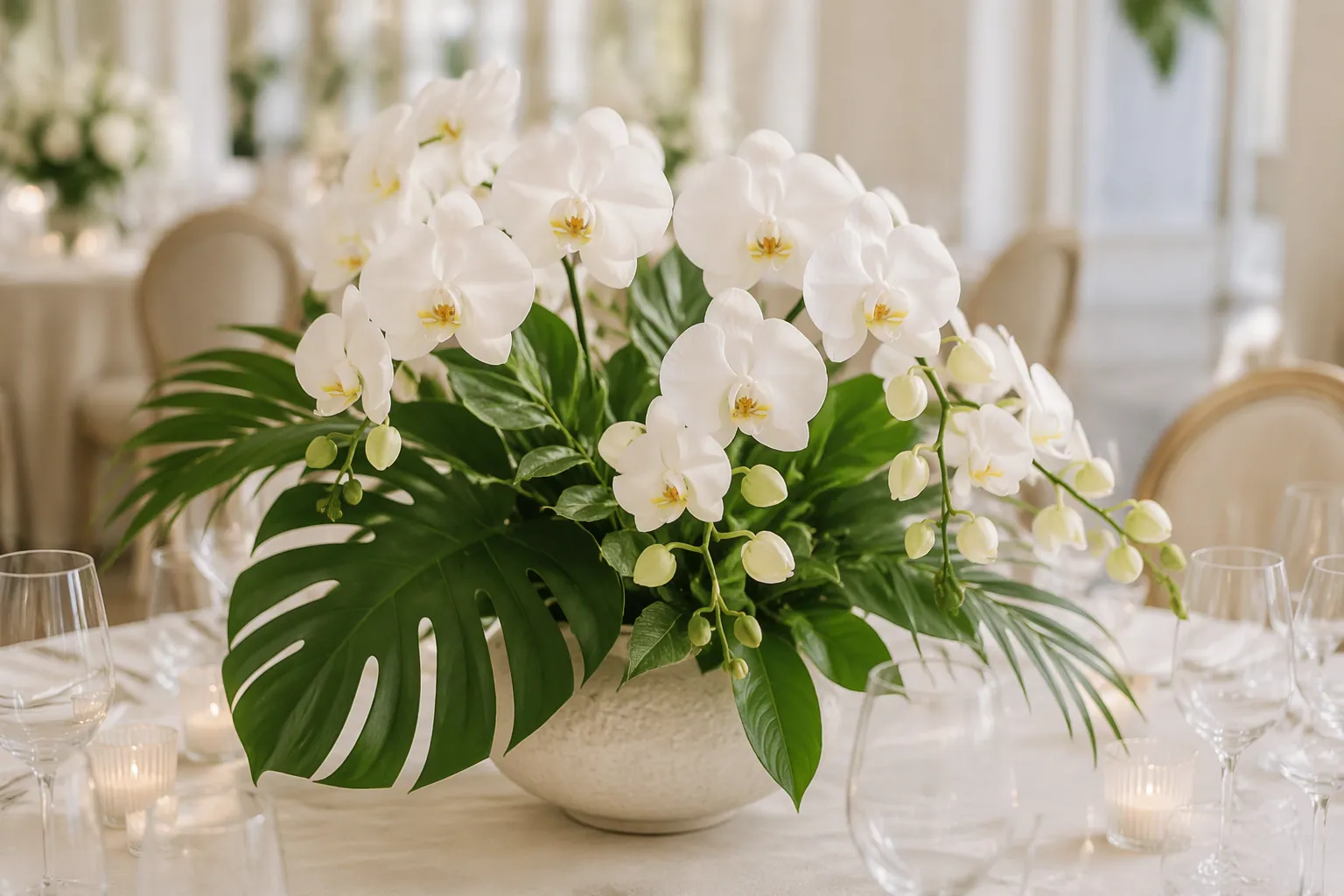
Cymbidium or phalaenopsis stems with monstera, palm and ti foliage in a low vessel. The look in this plate's cover image. Foliage does the volume work, orchids do the focal work, and the whole thing laughs at a warm room. $150–$300 per table.
The statement piece
For the escort card table, bar or sweetheart table: a large sculptural construction of phalaenopsis stems, branches and moss, sometimes three feet tall. One or two of these per wedding, not ten. $300–$600+ each.
Field note: the day early advantage
Because cut orchids hold for a week or more in water, orchid centerpieces can be built and delivered a day ahead of the wedding. When a venue allows only a two hour setup window, common at hotels and historic properties, that head start can be the difference between the florist you wanted and the florist who was available.
Orchids and everything else
Orchids play well with three families of companions. Tropical foliage: monstera, palm, fern: extends them naturally and cheaply. Roses and ranunculus soften their geometry for romantic styling; use cymbidium here, whose smaller blooms sit comfortably among garden flowers. And candlelight is the orchid's best friend: the waxy petals catch and hold light in a way matte petals don't, which is why submerged designs and candle clusters so often share a table.
One pairing to avoid: very cold rooms. Cymbidium tolerates chill; tropical phalaenopsis and vanda below about 13°C will show damage. If your reception is aggressively air conditioned, many ballrooms are, mention it to your florist.
A rose centerpiece is a race against the clock. An orchid centerpiece is furniture. It will look identical at midnight.
Pl. 05, working noteFrequently asked questions
Yes: orchids are among the best centerpiece flowers available. Their waxy petals hold for days without wilting, they tolerate warm reception rooms that defeat softer blooms, and a few stems carry an entire arrangement. Phalaenopsis offers the longest stems and most sculptural shape; cymbidium gives the most blooms per stem.
Expect $80–$150 per table for a simple submerged stem or potted orchid design, $150–$300 for a styled arrangement with tropical foliage, and $300 or more for large sculptural pieces. Potted orchids cost more upfront than cut flowers but go home with guests or the couple as living favors.
Phalaenopsis is the default for elegant centerpieces: long arching stems, large waxy blooms in white and blush. Cymbidium is the workhorse for color and durability in heat. Dendrobium is bought by the hundred for scattering and garlands. Vanda makes dramatic jewel toned statements, and oncidium adds dancing yellow texture.
Absolutely, and it's one of the smartest centerpiece moves. A potted phalaenopsis in a dressed container costs little more than a cut arrangement, is immune to wilting, doubles as a guest favor or keepsake, and survives the entire event without a florist's intervention.
Cut phalaenopsis and cymbidium stems last one to two weeks in water; individual blooms floated in bowls hold for days. So arrangements can be made a day ahead without risk. A genuine advantage when venue access is tight.
Sources & further reading
- Phalaenopsis: botanical background on the moth orchid
- Martha Stewart Weddings: orchid centerpiece styling features
- Brides: centerpiece pricing articles