No flower works harder at a wedding than the marigold. Strung by the thousand, it carries entire ceremonies on its shoulders, and asks almost nothing in return.
The marigold (Tagetes) is the backbone of Indian wedding florals: auspicious in meaning, indestructible in heat, and astonishingly affordable per foot of coverage. Its saffron and gold palette echoes the sacred colors of Hindu ceremony, and its pom pom heads thread into dense ropes of color that no temperate flower can match at any price. For planners working on fusion and South Asian weddings in the US, UK and Australia, marigold styling is becoming standard knowledge, and for everyone else, the techniques transfer beautifully to any bold, joyful celebration.
Where the garlands go
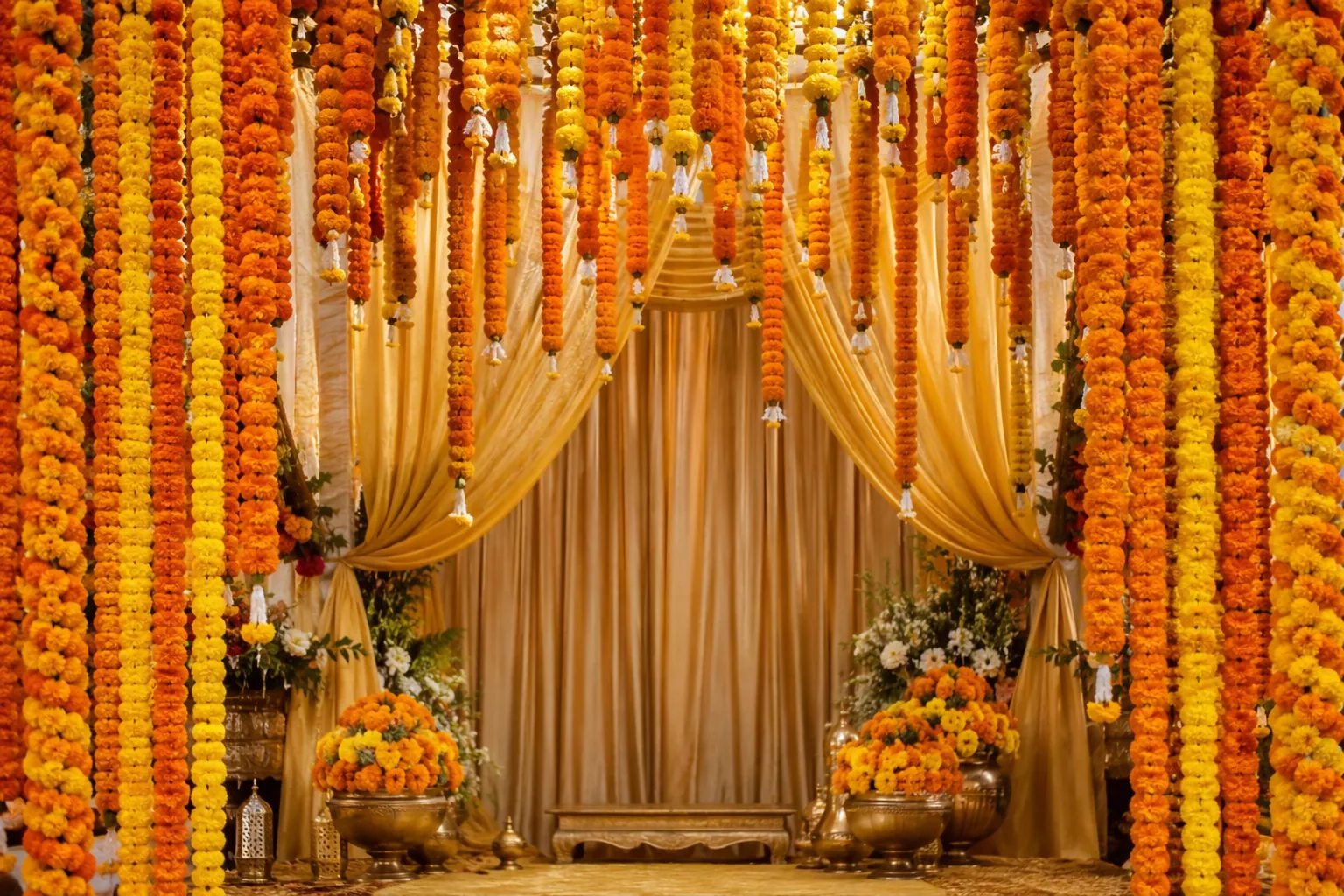
- Haldi. The turmeric ceremony is marigold's home ground, strands hung as a backdrop behind the couple's seats, often against gold or mustard drapery that doubles the glow. This is the most photographed marigold moment of the week.
- Mehndi. Looser and more playful: garlands framing low seating, strung overhead between posts, or braided with fairy lights for evening events.
- Mandap and stage. Vertical strands line the mandap pillars or form the ceremony backdrop, traditionally mixed with mango leaf and sometimes jasmine. A full marigold mandap is one of the great sights in wedding design.
- Entrances and thresholds. Strands hung in doorways (a cousin of the toran tradition) so guests walk through curtains of gold. The cheapest transformative decor in the entire wedding budget.
- Jaimala / varmala. The exchanged garlands themselves: heavier, longer strands the couple places around each other's necks mid ceremony.
The strand math
Standard marigold strands run 4.5 to 5 feet, threaded with fifty to seventy heads each. The planning math:
| Application | Coverage rule | Example |
|---|---|---|
| Full backdrop, dense | 1 strand per 3–4 in of width | 8 ft wall → 25–30 strands |
| Backdrop, airy (with drapes) | 1 strand per 6–8 in | 8 ft wall → 12–16 strands + fabric |
| Mandap pillars | 6–10 strands per pillar | 4 pillars → 24–40 strands |
| Doorway curtain | 10–14 strands per doorway | 2 entrances → 20–28 strands |
| Jaimala pair | 2 heavy strands | Custom made, longer and denser |
Fresh strands typically cost $3–$8 each depending on region and season, meaning a full 8-foot backdrop runs $100–$240 in materials, a fraction of any comparable floral treatment. Installation labor is the larger line: hanging thirty strands neatly takes a practiced crew an hour or two.
Field note, order the buffer
Order 10–15% more strands than the math says. Some arrive bruised, some break in hanging, and the leftovers fill gaps nobody foresaw. A bare pillar, a dull corner of the bar. At $5 a strand, the insurance is trivial.
Fresh vs artificial
Fresh marigolds are genuinely hardy, among the best event day survivors in the cut flower world, but they are still a single day product. The decision matrix:
- Fresh for the mandap, the Haldi backdrop, and anything close to guests: the scent and the slight organic irregularity are the point.
- Artificial for multiday installations (Mehndi today, reception in three days), for entrances and perimeters installed a day early, and where fresh supply is unreliable. Quality artificial marigold strands are convincing at two meters and reusable across events.
- Mixed is the professional norm: fresh where noses and cameras go, artificial where only wide shots reach.
Pairing the palette
Gold drapery is the classic partner, marigold strands against gold fabric is the signature look, and the reason Haldi backdrops photograph like they're lit from inside. Beyond tradition, three pairings modernize the palette: dark green foliage cools and grounds the orange; ivory and blush soften it for fusion weddings where marigold meets garden roses; and the monochrome discipline: all yellow, or all orange, in dense repetition, reads strikingly contemporary. The one pairing to approach carefully is red: marigold orange against true red vibrates rather than harmonizes.
Other flowers decorate a ceremony. Marigolds build one: strand by strand, until the room itself turns gold.
Pl. 07, working noteLogistics that count
- Timing. Fresh strands are strung the day before or the morning of the event. They're hardy, but they arrive perishable. Confirm the delivery to hanging window with your supplier.
- Hanging hardware. Strands hang from hooks, fishing line or a tensioned frame. On drapes, they're pinned through the fabric header. Nobody should be improvising this at 6 a.m. walk the rigging plan with the crew beforehand.
- Sourcing abroad. In the US, UK and Australia, Indian grocery districts and specialist South Asian wedding decorators are the reliable supply chain: mainstream florists rarely stock marigold in wedding volumes.
Frequently asked questions
Marigolds carry auspicious meaning across Hindu ceremonies. Their saffron and gold tones echo sacred colors, and their hardy, sun loving nature makes them symbols of brightness and prosperity. Practically, they're one of the few flowers that survive a full day of outdoor ceremonies in heat without wilting.
Standard garland strands run about 4.5 to 5 feet. For a full backdrop, plan one strand per 3 to 4 inches of width for dense coverage. An 8-foot-wide backdrop needs roughly 25 to 30 strands. Halve the density and mix with drapes or foliage for a lighter, more modern look.
Fresh marigolds have the scent, the slight irregularity, and the tradition, and they hold up remarkably well for a single event day. Artificial garlands make sense for events spanning many days (Haldi one day, Mehndi the next), for early installation, or where fresh supply is unreliable. Many families mix: fresh at the mandap, artificial for entrances and perimeter.
Gold drapery is the classic partner: marigold strands against gold fabric is the signature Haldi and Mehndi backdrop. Beyond tradition: dark green foliage cools the palette, ivory and blush soften it for fusion weddings, and a single color marigold scheme (all yellow or all orange) reads strikingly modern.
Fresh marigold strands typically cost $3–$8 each depending on region and length: among the most affordable wedding flowers per foot of coverage. A full 8-foot backdrop of 25–30 strands runs $100–$240 in materials, with installation labor on top. Artificial strands cost similar money but are reusable across events.